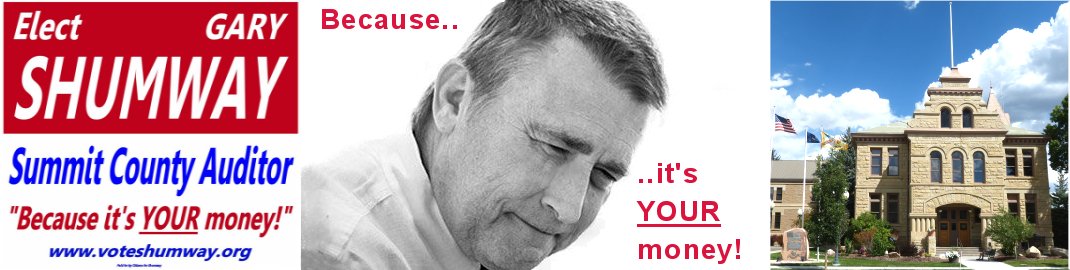
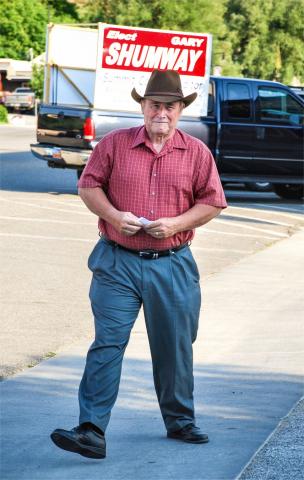
Alison Pitt mentions me in her response to the Park Record's question "Please differentiate yourself from your opponent." That is, Alison states (in part):
Mr. Robinson touts his experience of dealing with land use and water law. However, this experience is from the perspective of a large property owner interacting with staff and consultants under the old form of government. This is exactly the opposite of the new perspective and openness to fresh ideas that I will bring to the Council. Mr. Shumway and I agree on one issue—that local government races should not be partisan and that people should vote for the most qualified candidate, not the party—but I am the better candidate because I bring a unique perspective and a desire to lead a diverse County.
This non-partisanship question was also brought up in my 10/30/2008 KPCW radio interview with Randy Barton. That is, Randy asked me if I thought the Summit County Council race should be non-partisan. Frankly, I was a little taken aback by the question since I had never thought about championing that concept. I of course have stated over, and over, and over again that the voter should "vote person, not just party" and that all Democrats are not the same and ditto for the other parties. So to Randy's question I lamely stated that, in essence, the political party give and take get the political juices going and could get the voters charged up for the election. That said, I still closed the interview with, "vote person, not just party".
Based on the above, and the fact I used to say "vote person, not party" (leaving out the 'just') maybe I am not making myself clear on my person-party beliefs. Let me try again.
In a perfect world there would not be political parties, we would all research the candidates' positions on the topics of interest to us and vote for the person that best represents our point of view. But you see, right there, are the seeds for the establishment of political parties. That is, most humans are social animals and we generally prefer to spend our time around (or voting for) like thinking/behaving individuals, i.e., we identify with a group of individuals (along whatever lines the group is composed).
We humans also seek labels and containers in which to group our experiences. This makes it easier to respond to future experiences in a constructive (hopefully) manner and it makes life generally easier in that every time we deal with people we don't have to go through the process of re-evaluating their positions on issues. Instead we use the label of Republican or leftist or Mormon or whatever. This is both convenient and dangerous, as labels can be misleading and people can misuse labels. But I'm getting too far off my immediate topic to explore this further.
Suffice it to say, that believing you can have elections for public offices without the interjection of 'parties' is giving humanity too great a work load. It is tough enough to get the voters to review the positions of a few candidates vs. having them to sift through many candidates who have no convenient label for what they represent. Yes, it is not a perfect system since you can have the Dick Chaney's and the Ron Paul's in the same political party, but it is a start. Optimally the candidates will align themselves with the parties that best reflect their own beliefs. Of course this is not always true since in some areas there are dominant parties, so if one wants to get elected one runs on that dominant party's platform, regardless of their personal beliefs.
As to my politics, I identify with the Libertarian and Constitution parties and their general platform of smaller government, more freedom. But to that end I could also be a Ron Paul Republican or possibly a Blue Dog Democrat. So there, I've gone and used labels which in rough, general terms support my pragmatic paleolibertarianism beliefs (oops, another label).
In short, I don't think it is possible for individuals running for public office (school boards and the like are another subject) to divorce themselves completely from associating with a particular party. In part because the voter identifies themselves with a particular party (even if they are registered 'Independent' they generally vote this way or that way) and in part because of the value of standing on the shoulders of past politicians who contributed to the building of the party, thus making it easier to get donations, have access to political workers, and get elected. Which is one reason it is so difficult to run successfully on a third-party ticket.
We may not be able to rid ourselves of the party apparatus but we can still examine the candidates which are running for office across the parties. I will agree that I would not spend much time looking at candidates running on Socialist or Communist party platforms. The generally conceived policies of these parties are at odds with mine (see, the value of labels). But I should look at the Republican, Democrat and particularly the other third-party candidates.
Aside: I recognize it is tough to get excited about third-party candidates because so often they do not seriously run (do not spend the time, effort or are qualified), have limited budgets, and a constrained party apparatus to help get the vote out. And sometimes they are just weird! But I contend that in ignoring third-party candidates, one would also pass up candidates who are qualified, are serious about spending the time, money, and effort to run a campaign, and study the issues. Third-party candidates can enrich the choices we have for office and they often interject new topics for discussion or ways of approaching problems. End Aside.
Succinctly, to expect humanity to give up on political parties is, IMHO, a lost cause so the best we can do is to implore the voter to 'vote person, not just party'! Hopefully the voter will take the time to learn about the candidates and not just vote straight party. Voting straight party is an excellent way limit your choices and kill our democratic republic experiment.
Vote Person, Not Just Party!